A practical guide for instrumentation engineers & students

Master Instrumentation in Desalination Plants!

From Seawater Intake to Product Water – Understand Every Important Instrument, Analyser, Control Loop and Interlock.

Are you working in instrumentation, water treatment or desalination? Want to understand how instruments actually work in RO, MSF and MED plants?

This practical ebook takes you through the complete desalination process and explains where instruments are installed, why they are required and how they work together to operate and protect the plant.

  • Understand instrumentation throughout a desalination plant.
  • Learn practical applications of transmitters, analysers, control loops and interlocks.
  • Improve your technical understanding with practical examples and diagrams.
Get This Ebook
Digital PDF Ebook Instant Access After Successful Payment
Instrumentation in Desalination Plants ebook by Sanjay Kumar – 3D cover
15 Detailed Chapters RO + MSF + MED Practical Instrumentation PLC / DCS / SCADA Troubleshooting & Quiz
Be honest with yourself

Do you really understand how instrumentation works in a desalination plant?

?

You know what a pressure transmitter does — but do you know where and why it is installed in an SWRO plant?

?

Do you understand why ORP measurement is critical before RO membranes?

?

Do you know how differential pressure is used to monitor filter clogging?

?

Can you explain how an energy recovery device works and which instruments are required around it?

?

Do you understand the control loops and interlocks used in RO plants?

?

Do you know the instrumentation differences between RO, MSF and MED plants?

Knowing instrumentation theory is important. Understanding how it is applied in an actual process plant makes you a better instrumentation professional.
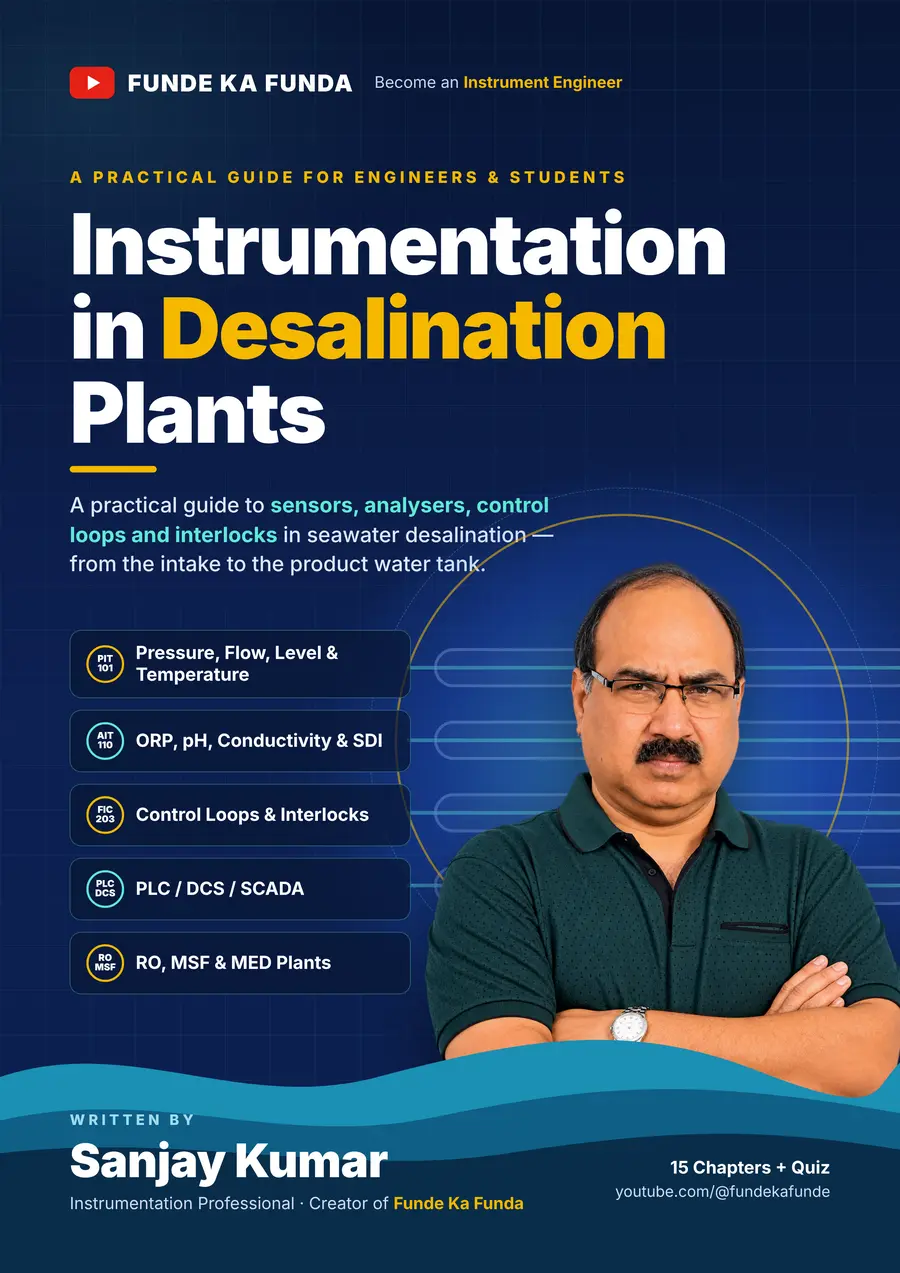
Introducing

Instrumentation in Desalination Plants

This ebook is a practical technical guide covering instrumentation applications across the complete desalination process.

It follows the water from seawater intake and pretreatment through the RO process, energy recovery, post-treatment and product water storage. It also explains instrumentation used in thermal desalination plants.

Intake→Pretreatment→Chemical dosing→HP pump & RO→Energy recovery→Post-treatment→Product tank
01

Complete Process Coverage

Understand instrumentation from seawater intake to final product water.

02

Practical Instrumentation

Learn about pressure, flow, level, temperature and analytical instruments.

03

Control & Automation

Understand control loops, PLC, DCS, SCADA and protective interlocks.

04

Field Application

Learn about installation, calibration, troubleshooting and common mistakes.

Chapter-wise content

What will you learn?

15 chapters that walk through the plant section by section — tap any chapter to see what it covers.

CH 01Desalination at a Glance

The processes, the numbers and why instrumentation matters so much.

  • Membrane (RO) and thermal (MSF, MED) desalination.
  • Main sections of a seawater RO plant and the key measurements in each.
  • Key operating numbers: salinity, HP pump pressure, recovery, specific energy.
  • Why many desalination instruments are protective, not just “measuring”.
CH 02Instrumentation Basics Refresher

The building blocks you will meet on every P&ID of a desalination plant.

  • Reading ISA-5.1 instrument tags (PIT, FIT, AIT, PDIT, LIT).
  • The 4–20 mA loop, mA-to-engineering-unit conversion and live zero.
  • Switches versus transmitters, and deadband.
  • Accuracy, precision and repeatability.
  • Gauge, absolute and differential pressure.
CH 03Seawater Intake and Screening

Watching the raw water before it enters the plant.

  • Open and subsurface intakes.
  • Sump level and screen differential level — radar vs ultrasonic.
  • Raw-water monitoring: temperature, conductivity, turbidity, oil-in-water, chlorophyll.
  • Toroidal conductivity sensors for seawater.
  • Intake chlorination control.
CH 04Pretreatment Instrumentation

Removing particles and colloids that would foul the RO membranes.

  • Turbidity measurement (nephelometric, NTU).
  • Silt Density Index (SDI) test to ASTM D4189 and how to read it.
  • Filter differential pressure and backwash triggers; UF monitoring.
  • Cartridge filter ΔP — what a rise and a sudden drop mean.
  • Flow-paced coagulant dosing control.
CH 05Chemical Dosing and Water Chemistry Analysers

Dechlorination, ORP, pH, antiscalant and the analysers that guard the membranes.

  • Why chlorine must be removed before polyamide RO membranes.
  • Sodium metabisulfite (SMBS) dosing.
  • ORP measurement and membrane protection, with alarm and trip points.
  • pH measurement and acid dosing.
  • Antiscalant dosing.
  • Chemical dosing interlocks.
CH 06High-Pressure Pump and RO Train

Pressures, flows, recovery control and the interlocks that protect pumps and membranes.

  • SWRO high-pressure pump instrumentation.
  • Feed and permeate flow measurement.
  • Recovery control.
  • Pressure and differential pressure monitoring.
  • Start-up ramp and permeate back-pressure protection.
  • Pump and RO train interlocks.
CH 07Energy Recovery Devices

Recycling brine pressure — and the instruments that keep it balanced.

  • Why energy recovery is essential in SWRO.
  • Isobaric pressure exchanger working.
  • High-pressure and low-pressure flow measurement.
  • Booster pump control.
  • Flow balancing and conductivity monitoring.
CH 08Flow Measurement in Desalination

Choosing the right flowmeter for seawater, brine, permeate and chemicals.

  • Which flow technology is used where.
  • Why magnetic flowmeters dominate seawater service.
  • Handling low-conductivity permeate.
  • Ultrasonic, vortex, DP, Coriolis and rotameters.
  • Installation rules, common errors and mass-balance checks.
CH 09Pressure, Level and Temperature

The workhorse measurements — applied to RO trains, tanks and thermal plants.

  • Pressure transmitter selection for 70-bar seawater service.
  • Measuring ΔP across RO vessels; DP calibration and manifolds.
  • Level measurement in tanks, sumps and CIP systems.
  • RTDs and thermowells, and why temperature is vital for RO normalisation.
CH 10RO Performance Monitoring and Cleaning

Turning instrument readings into decisions: normalisation, trends and CIP.

  • Why raw RO readings mislead.
  • Normalised permeate flow, salt passage and differential pressure.
  • Which instruments feed the calculation, with accuracy tips.
  • Typical cleaning triggers.
  • CIP system instrumentation.
CH 11Post-Treatment and Product Water

Making permeate stable, safe and drinkable — and proving it.

  • Second-pass RO and boron control.
  • Remineralisation with CO₂ and lime or calcite.
  • pH, alkalinity and corrosion indices (LSI).
  • Final disinfection and chlorine analysers.
  • Product water tank, quality monitoring and brine outfall monitoring.
CH 12Instrumentation in Thermal Desalination

MSF and MED plants: temperature, vacuum, level and distillate quality.

  • How MSF and MED (including MED-TVC) plants work.
  • Top brine temperature control.
  • Vacuum and non-condensable gas removal.
  • Stage and effect level control.
  • Distillate conductivity and dump logic.
CH 13Control Systems and Automation

PLC, DCS and SCADA — sequences, loops and alarm management.

  • Levels of automation in RO plants.
  • Typical control system architecture.
  • Main control loops across the plant.
  • Automatic sequences: start-up, shutdown, flushing, backwash, CIP.
  • Alarm management and data historians.
CH 14Materials, Installation, Calibration and Troubleshooting

Making instruments survive — and stay accurate — in seawater.

  • Material choices for seawater instruments.
  • Analyser sample system design.
  • A practical calibration and maintenance plan.
  • A troubleshooting table for common problems.
CH 15Test Yourself – Funde Ka Funda Quiz

20 questions in the style of the daily channel quiz, followed by answers and explanations.

  • Multiple-choice questions on the topics covered in the book.
  • Answers with short explanations.

Also included: Glossary of common terms and abbreviations, and a list of References and Further Reading.

Get This Ebook
Digital PDF Instant access after successful payment
Special features

More than just instrumentation theory!

Practical notes are shown in coloured boxes throughout the book, alongside diagrams, tables and a self-test quiz.

Funde Ka Funda Concept

Core instrumentation principles applied to real desalination processes.

Field Tips

Practical installation, commissioning and maintenance advice.

Watch Out

Common mistakes that lead to wrong readings, trips and equipment problems.

Process Diagrams

Simplified technical diagrams to understand instrument locations and process applications.

Control Loops

Understand how measurements interact with control systems.

Troubleshooting

Practical guidance on calibration and instrumentation problems.

Self-Test Quiz

Test your understanding with the Funde Ka Funda quiz chapter.

Reference Tables

Typical values, instrument selection tables, interlock lists and a calibration plan in one place.

Actual boxes from the ebook — tap to enlarge
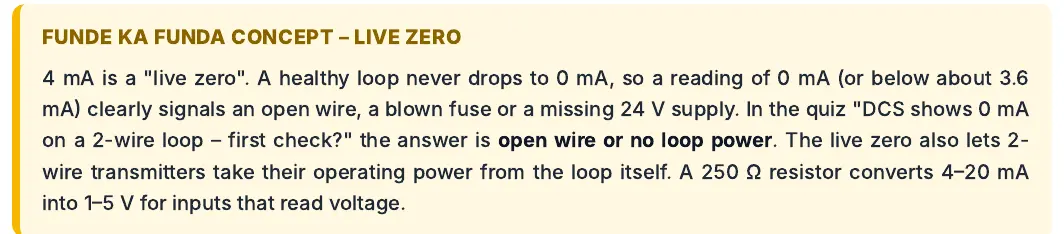
Funde Ka Funda Concept box about the 4 mA live zero, from Chapter 2
Funde Ka Funda Concept · Chapter 2
Field Tip box about intake analysers, from Chapter 3
Field Tip · Chapter 3
Watch Out box about bypassing ORP trips, from Chapter 6
Watch Out · Chapter 6
Who should buy this ebook?

Who will benefit from this ebook?

Instrumentation Engineers

Engineers working in water treatment, desalination and process industries who want to strengthen their practical knowledge.

Instrumentation Technicians

Technicians involved in field instruments, calibration, commissioning and maintenance.

Engineering Students

Students who want to understand how instrumentation concepts are applied in actual industrial plants.

Process & Plant Operators

Professionals who want to understand instrument readings, alarms, control loops and equipment protection.

Why choose this ebook?

Why this practical guide is worth reading

Typical theoretical learning

  • Learn individual instrument principles.
  • Study measurement theory.
  • Understand isolated examples.

This practical guide

  • Connects instruments with the complete desalination process.
  • Explains where and why instruments are installed.
  • Shows how instruments support process control and equipment protection.
  • Covers RO as well as thermal desalination.
  • Explains practical field considerations and troubleshooting.

Theory and application go together — this book builds on the basics and shows them at work inside a real process.

Sanjay Kumar, author of Instrumentation in Desalination Plants Creator · Funde Ka Funda
About the author

Learn from an experienced instrumentation professional

Sanjay Kumar

Instrumentation professional and creator of Funde Ka Funda

Funde Ka Funda is an educational platform dedicated to helping instrumentation engineers, technicians and students improve their technical knowledge through daily instrumentation quizzes and explanations. The explanations from those quizzes form the “Funde Ka Funda Concept” boxes in this book.

  • Temperature measurement
  • Pressure measurement
  • Flow measurement
  • Level measurement
  • Analytical instruments
  • Control valves
  • PLC and DCS
  • Industrial automation
Ebook preview

Take a look inside the ebook

Actual pages from the ebook. Tap any page to enlarge it.

Instant digital download

Get your copy today!

Digital PDF Ebook

Instrumentation in Desalination Plants

Author: Sanjay KumarFormat: Digital PDF Ebook
…
  • Complete 15-chapter technical guide.
  • Covers RO, MSF and MED.
  • Practical instrument applications.
  • Control loops and interlocks.
  • Installation and troubleshooting.
  • Self-test quiz.
  • Digital PDF access after successful payment.
Get This Ebook
Secure payment through our payment gateway.
Digital ebook – no physical shipment.
After successful payment, you will be redirected to the ebook download page.
FAQ

Frequently asked questions

What is this ebook about?

It explains what is measured, where, why and how in a desalination plant. It follows the water from the sea intake, through pretreatment, chemical dosing, the high-pressure RO section and energy recovery, to post-treatment and the product water tank. Separate chapters cover thermal plants (MSF and MED), control systems, materials, calibration, troubleshooting and a self-test quiz.

Who should read this ebook?

Students of instrumentation, electrical, chemical and mechanical engineering; instrument and control engineers and technicians joining or working in a desalination or water treatment plant; and operators and process engineers who want to understand the readings, alarms and trips on their screens.

Does it cover both RO and thermal desalination?

Yes. Most of the book follows a seawater reverse osmosis (SWRO) plant, and Chapter 12 is dedicated to thermal desalination — multi-stage flash (MSF) and multi-effect distillation (MED, including MED-TVC) — covering top brine temperature control, vacuum and absolute pressure measurement, stage and effect levels, and distillate conductivity with dump logic.

Does it explain PLC and DCS applications?

Yes, from an application point of view. Chapter 13 covers levels of automation in RO plants, a typical PLC / DCS / SCADA architecture, the main control loops, automatic sequences (start-up, shutdown, trip, backwash, CIP) and alarm management with data historians. Interlocks and cause-and-effect logic appear throughout the book. It is not a PLC programming course.

Is this ebook suitable for students?

Yes. Students are one of the main audiences. Chapter 2 is a refresher on instrument tags, the 4–20 mA loop, switches vs transmitters, accuracy and pressure references, and every chapter starts with clear learning goals. The quiz in Chapter 15 helps you check your understanding.

What format will I receive?

A digital PDF ebook. It opens on mobile phones, tablets and computers with any standard PDF reader.

How will I download the ebook after payment?

Click Get This Ebook and complete payment on our secure payment gateway. After successful payment you will be redirected to the download page, where you click Download Your Ebook – PDF. If you have any trouble, contact us at support email with your payment details.

Will I receive a physical printed book?

No. This is a digital ebook only — nothing is shipped.

Can I share or redistribute the PDF?

No. The ebook is © 2026 Sanjay Kumar, all rights reserved. It may not be reproduced, resold or redistributed in any form without written permission from the author, except for short quotations used in reviews or for teaching with credit to the source. If a friend finds it useful, please send them to this page.

Can I use the typical values and setpoints directly in my plant?

No. The ebook is written for education and training. Typical values, setpoints and ranges are given to help you understand how desalination plants are instrumented — they are not design values for any specific plant, and membrane, pump, energy-recovery and analyser limits vary between manufacturers and models. Your plant’s P&IDs, cause-and-effect charts, vendor manuals, applicable standards and site safety rules must always take precedence before configuring, calibrating or bypassing any instrument or interlock.

Get This Ebook
Secure payment Digital PDF

Take your instrumentation knowledge to the next level!

Understand how instrumentation works across a complete desalination plant – from seawater intake to product water.

Get This Ebook Now

Digital PDF Ebook Instant access after successful payment